I frequently attend the ESWC conference: it’s usually in a nice location in Europe and there is a very welcoming core community of researchers that are both supportive as they dare to challenge you to always come with exciting contributions year after year.
The Organizing Committee and the first ever student mentoring program
The organizing committee changes each year. This year, the general chair was Maribel Acosta. After chairing the PhD symposium last year, I was asked by Maribel to help with creating a welcoming environment for students at the conference by being the first ever student mentor chair. Maribel already made sure that after every presentation in the main track, students would get the first chance of asking a question. A genius idea I found: students that way feel more inclined to participate, but they also tend to ask the more interesting questions.
I asked my colleagues Wout and Ruben to help me out for organizing social events by organizing an online chat group that ended up attracting 62 members. The chat group was used to align after conference activities, but also to announce our pre-conference get-together to talk about today’s program. At 8:20 we would convene in one of the conference rooms and run over the program of that day. There are certainly some particularities at ESWC, such as the Minute Madness, the town hall meeting, or the different tracks (resource, in-use, research, ...). In the morning session I thus invited the session chairs of the day to pitch their session and be available for a Q&A about it. I then also invited the keynote speaker right before their talk, to come and meet the students, and tell them what they can expect from the talk.
These morning sessions were well attended despite the early hour. The verdict? Let’s keep this role in the program committee in close collaboration with the PhD symposium. We’ll organize it again next year!
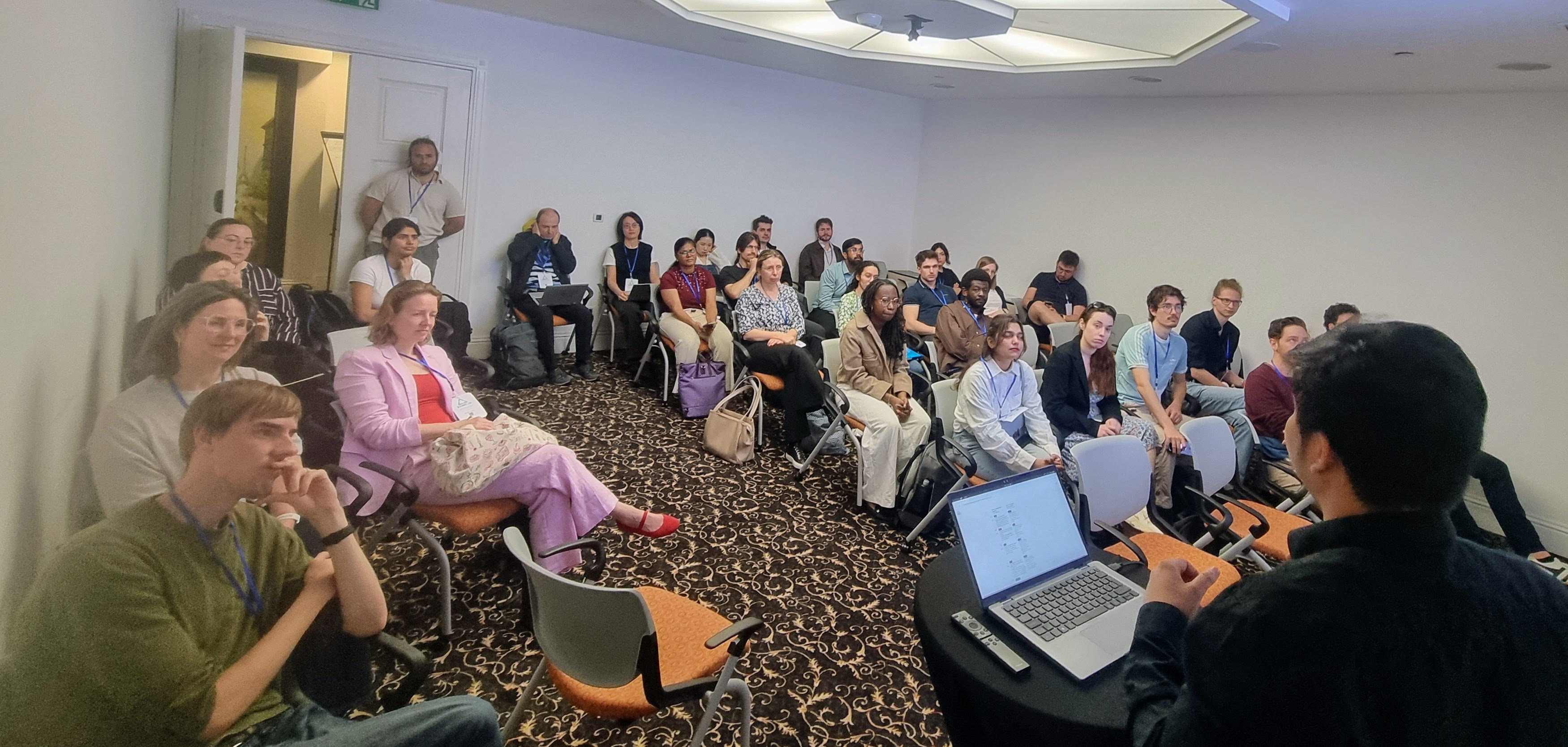
Day 1: The Semantics in Data Spaces workshop
This is a workshop I’m co-organizing for the third time in a row now. This year we didn’t have a keynote as we had 19 (the highest number so far) papers accepted and simply did not have room in the program for one. I found the presentations of very high quality this year: engaging, a lot of variety, and we were able to have very open and interesting discussions. The format of the workshop, with use case lightning talks interleaved with 10 or 15 minute paper presentations was a good idea. The fishbowl session at the end is something to keep.
The fishbowl discussion is a format in which 3 people in the front can start discussing, but anyone in the audience can tap the shoulder of someone in front to take over the discussion slot. The most interesting outcome of the discussion for me was the comment from Yassir Sellami (GAIA-X): our community should study dataspaces and their challenges, and define benchmarks that can provide a more neutral basis for study.
New this year were also the fast-paced lightning talks for showing use cases. We should keep this as is next year: it keeps the workshop interesting and dynamic.
Other memorable events from this year’s SDS for me personally were:
- The vision of Emanuel Sallinger and Axel Polleres on “From Data Spaces to Agent Spaces” hit the right nerve: AI systems do need policy guardrails that can be provided by tooling we have been building for the past years.
- The discussion with Christoph Braun and Lukas Kubelka on whether discovery includes data search or not
- The demo of the Keasy pipeline showing that knowledge engineering can be beautiful
- The demo of an interactive simulator for dataspaces by Finn Elbl (paper) - this can make dataspace engineering much more tangible. E.g., “look what happens when we now add 5 more actors in this ecosystem: interoperability and trust problems occur here and here, and the findability of datasets decreases”.
Due to me co-organizing SDS, I sadly missed other workshops I would have loved to attend such as KGCW, SemDH, and the ODRL tutorial.
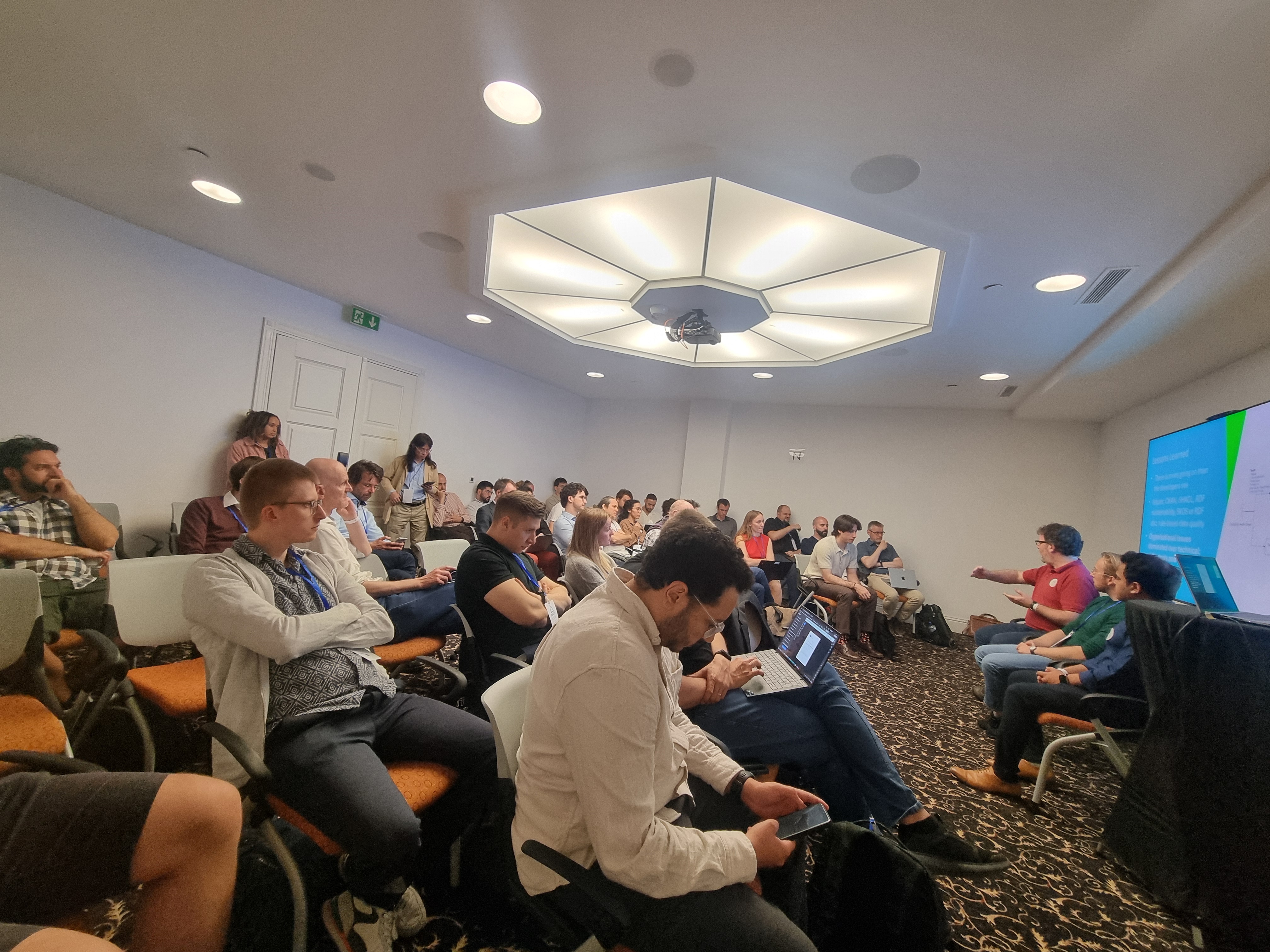
Day 2: various workshops and the PhD symposium
Monday is a room-switching day! Next to checking out the PhD symposium, the OPAL workshop, a tutorial on Navigating Reference Data, and the QKG workshop, I mainly talked to a lot of people, did some deep-focused work on the side for a SEMANTiCS submission, and the LDES and RDF Messages specification.
Day 3: the first day of the main track
From the keynote by Maria-Esther Vidal I learned about the 3 waves of AI, in which the third wave is a synthesis in which neurosymbolic AI, learning and reasoning come together. I also learned about this paper, already from 2023 by a whole range of academic heroes of mine on combining machine learning with the Semantic Web. It was nice to hear about PALADIN, which is a source-agnostic language to define process-based constraints. In Trustflows we certainly need to be able to express constraints on top of systems with many process stages, such as in use cases regarding medical treatment stages, supply-chain stages, employee workflows, etc. This is a note to self to check out the example test cases in PALADIN for implementing process constraints with Eyeling, RDF Messages and N3.
Also a nice reminder was about Boxology. I remember seeing earlier presentations about it but never applied it in my own work so far. It is a visual design-pattern language for hybrid / neuro-symbolic AI systems. It gives you a controlled “box-and-arrow” vocabulary for describing how data-driven components such as ML models and knowledge-driven components such as ontologies, rules, KGs, and reasoners are combined. Maria-Esther showed the tooling her lab built with tool4boxology.
Other memorable presentations of that day include:
- In-use paper by IBM: Context-Aware Visual Multi-Turn Conversation Generation from Wikipedia and Wikidata
- A cool piece of work was by Toky Raboanary and Maria Keet for generating competency questions from OWL-DL. Based on the work, Jos De Roo got excited and implemented the work as well in an Eyeling/N3 example for generating competency-style questions from ontological patterns, with Markdown output here: ontology-question-generation.md
The day continued with the Minute Madness! This is a session in which all posters and demos get one minute to introduce their work.
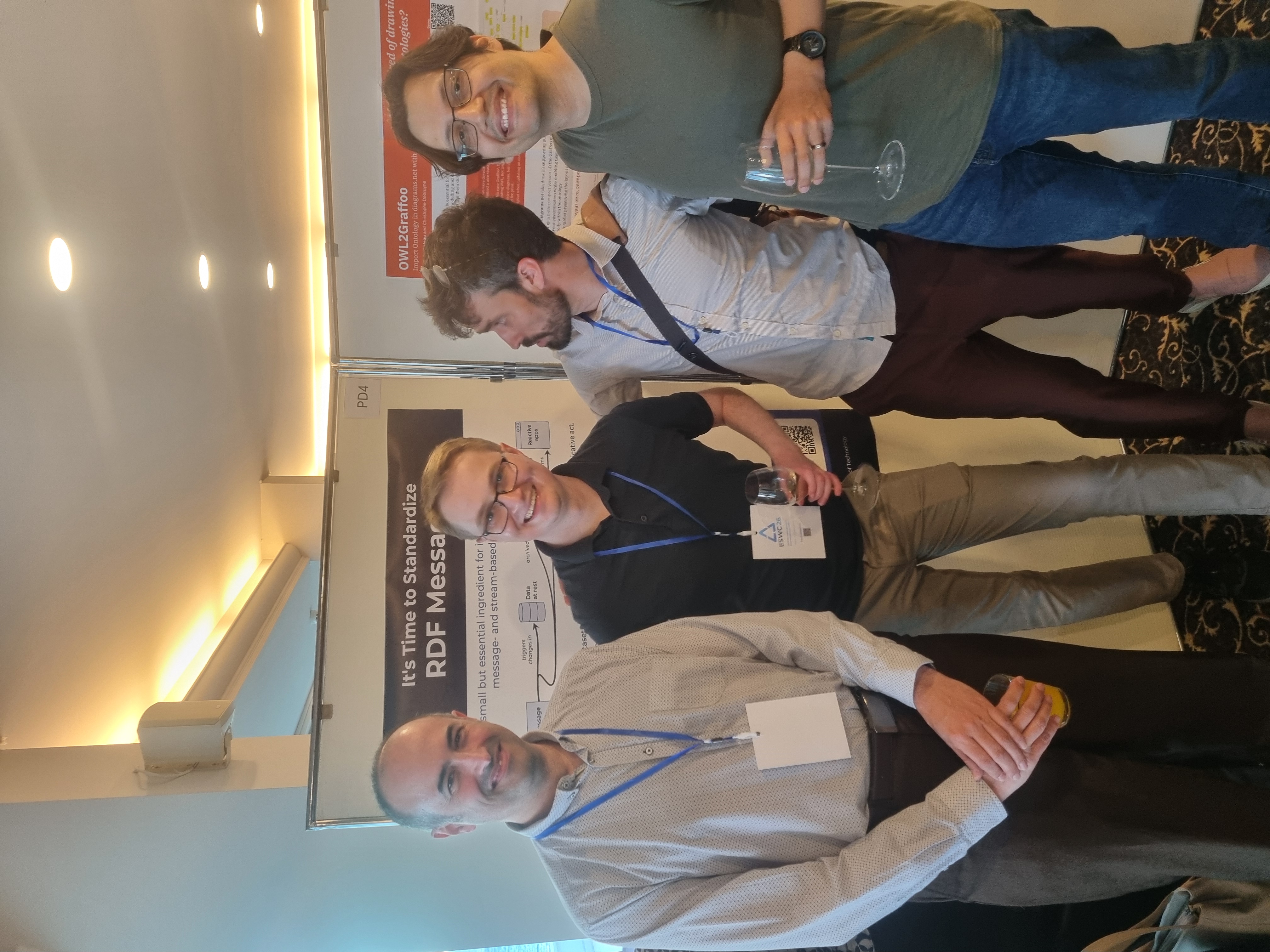
After the Minute Madness, the actual poster session happened. Multiple contributions from our team were presented. I showed our work with Piotr Sowiński on RDF Messages.
I also checked out other demos. Most memorable? Olaf Hartig that showed how he is able to include non-RDF data in a federated SPARQL query result and the Nemo demo (see later).
Day 4: The second main track day
Keynote by Isabelle Augenstein: her work focuses on fair and accountable NLP, explainability, factuality, and bias detection; useful context for the fact-checking and LLM-heavy parts of the program. Her keynote set the tone for the day, and I found the discussions around fair NLP, explainability, factuality, and bias detection especially useful for the fact-checking and LLM-heavy parts of the program.
Memorable presentations on this day for me personally included:
- From RDF Graph Validation to RDF Dataset Validation with SHACL-DS by Davan Chiem Dao and Christophe Debruyne that discusses support for named graphs in SHACL.
- SemTS: Ontology and Vocabularies for the Semantic Categorization of Time Series Knowledge, which is useful for our work on LDES, RDF Messages, and RDF Time Series Snippets.
Day 5: The third day of the main track
The keynote today was by Atanas Kiryakov. He brings the Graphwise/Ontotext and GraphDB perspective on industrial knowledge graphs and semantic databases. After his talk I asked a question about his view on eventual interoperability: is it better to reuse early and align later on, or to align early on? He mainly pointed out in his answer the benefits of reuse: there’s a lot of expert knowledge available in these ontologies that can give your project a head start. Not the answer I thought I was going to get, but I agreed: if there’s a very good ontology out there, it would not be smart not to reuse.
A paper I found memorable was the paper on CANDI, that enables data integration for CAN-bus data from vessels. I also saw clear links to my own work: our RDF Messages proposal could help with archiving those message logs, and our early RDF Time Series Snippets work may be useful for compactly representing AIS-like message streams. It’s always nice to see these talks that inspire your own work.
Finally, I chaired a session on Querying and Searching Knowledge (II), so I gave it my fullest attention as it was also closest to my interest.
- The first talk was one from our team Traqula: Providing a Foundation for The Evolving SPARQL Ecosystem Through Modular Query Parsing, Transformation, and Generation , presented by Jitse and Ruben.
- The next presentation was Proving Soundness of SPARQL Query Results using Selective Disclosure of RDF Datasets and Zero-Knowledge Proofs by Christoph Braun, which was interesting for trust, verifiability, and selective disclosure over RDF datasets. It was cool to see that the problem to be solved has multiple solution paths, and multiple of these paths are being researched at the same time. The presentation was of a very high level: it is difficult to explain selective disclosure to a broader audience, but Christoph did a phenomenal job here.
- I also enjoyed Towards Context-Aware Search: Dynamic Facet Generation in Digital Libraries , an in-use paper useful for practical search interfaces over semantic collections.
- The session closed with SPARQLing Datalog for Rule-Based Reasoning over Large Knowledge Graphs , which is central to my interest in rule-based reasoning at scale. In our work we’ve always looked at reasoning as something that could be done in memory. Alex’s work goes beyond that and sees source selection from SPARQL endpoints as a core concern in his datalog engine. It’s particularly commendable when you can also come with a nice in-browser demo that you can play with. Test it here!
Our Knowledge on Web-Scale team at ESWC2026
Our KNoWS team is strongly represented at ESWC 2026: we have papers, demos, posters, workshop roles, tutorials, and PhD mentoring activities throughout the week. I am co-organizing the Semantics in Dataspaces workshop, helping with PhD mentoring beyond the PhD symposium, presenting work on RDF messages, and following the papers that touch on data spaces, Linked Data publishing, policy-aware data sharing, RDF streams, querying, and practical knowledge graph engineering.
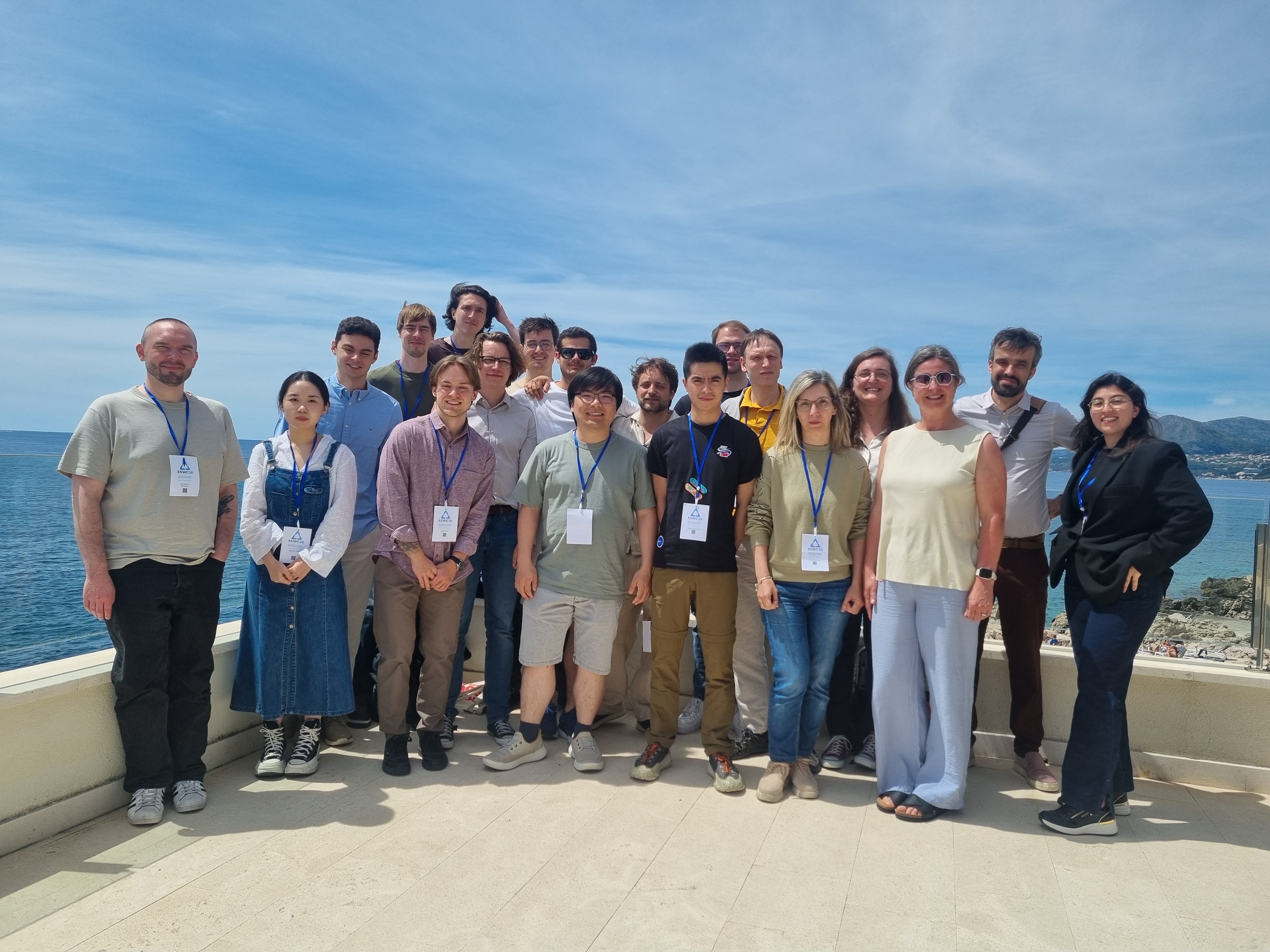
If you liked this, I’d also recommend reading the trip report of Paul Groth: it’s interesting to see how he experienced the conference from his perspective (which is different given our varying backgrounds), and how there are also clear overlaps.
Papers I co-authored at ESWC2026
- Context Associations: an Application-Independent Annotation Method for RDF Knowledge Graphs (QKG)
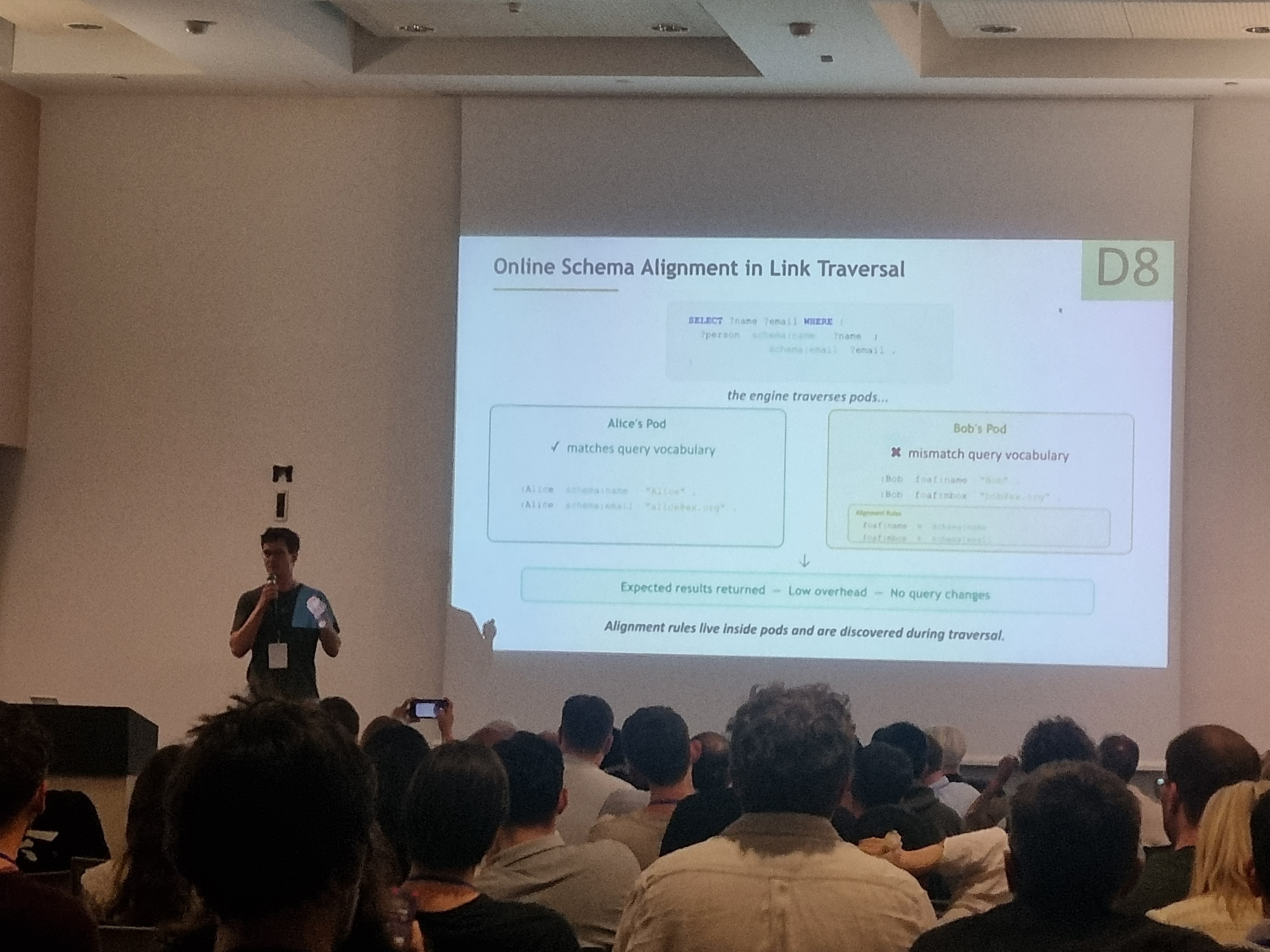
- Demonstrating Online Schema Alignment in Decentralized Knowledge Graphs Querying (Demo)
- It’s Time to Standardize RDF Messages (Poster)
- Monitoring water using an RDF-based Water Data Space (Demo)
- RML Playground: Online Editing, Validation, and Execution for the RDF Mapping Language (KGCW)
- The Vocabulary Hub as a Catalog for Semantic Artifacts for Discovery and Alignment of Datasets (SDS)