On the first day in the morning, I followed the workshop on data spaces, with the great Marcello Grita rocking the stage as the moderator. The biggest takeaway for me was in the talk of Valentina Staveris: she explained the SIMPL project to empower European data spaces. It consists of three main parts:
- SIMPL-Open: an open-source software stack that powers data spaces and other cloud-to-edge federation initiatives.
- SIMPL-Labs: an environment for data spaces to experiment with open-source software and assess their level of interoperability with SIMPL. Specifically, sectoral data spaces in their early stages will be able to experiment with the deployment, maintenance, and support of the open-source software stack before deploying it for their own needs. Furthermore, more mature data spaces will be able to use SIMPL-Labs to assess their level of interoperability with SIMPL-Open.
- SIMPL-Live: distinct instances of the SIMPL-Open software stack deployed for specific sectoral data spaces where the European Commission itself plays an active role in their management.
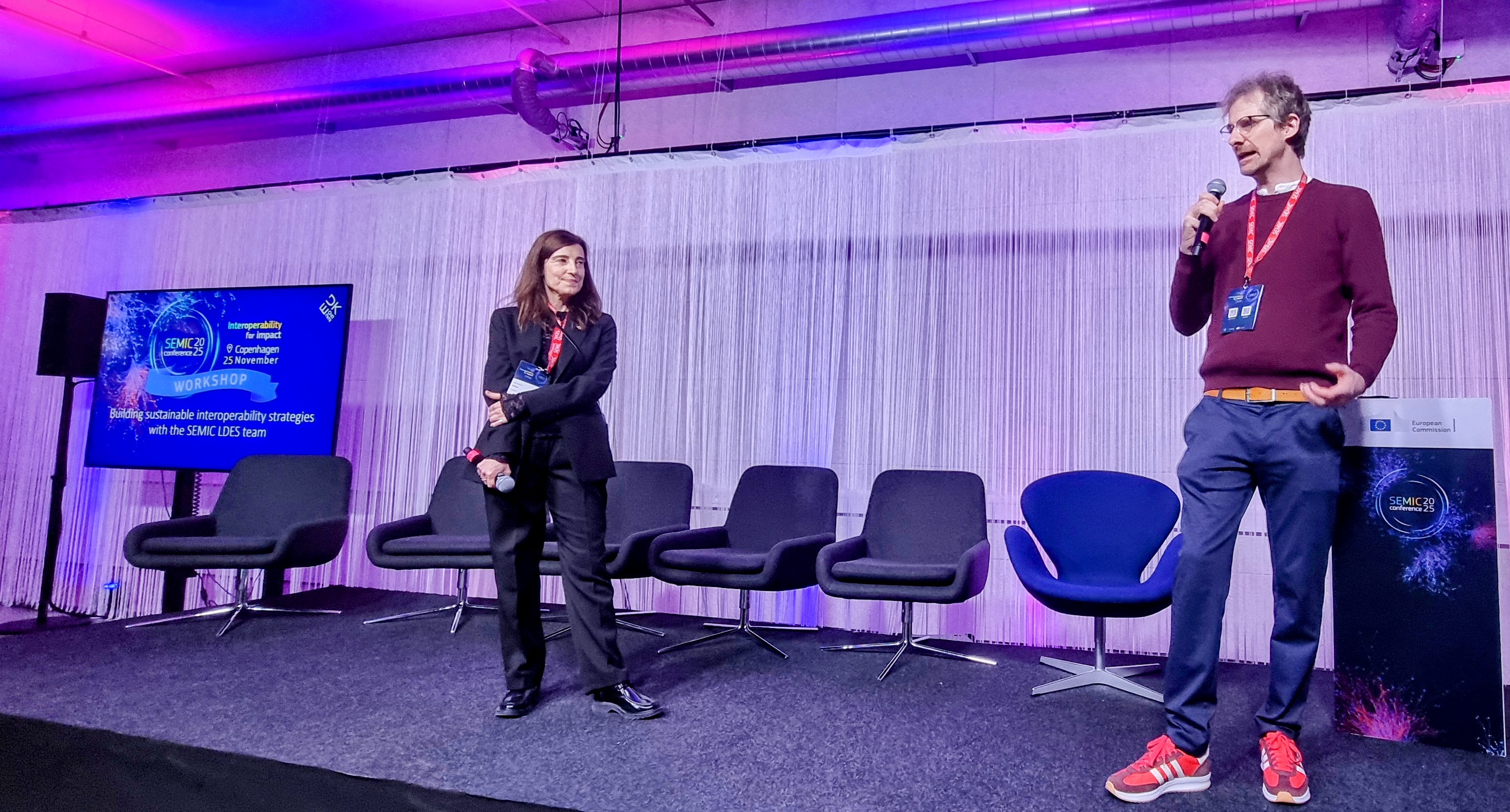
In the afternoon, we held our Linked Data Event Streams workshop. Anastasia Sofou and Sander Van Dooren opened the session and introduced the theme of the workshop: towards more sustained interoperability with LDES. Emilija Stojmenova Duh then introduced interoperability from the perspective of the next-generation European Interoperability Framework that is on its way.
The keynote was given by Piotr Sowiński of the company Neverblink. He presented his work on Jelly and how we are already collaborating on a spec called RDF Messages as part of the RDF Stream Processing community group. This way, Jelly and LDES share a common basis to build on.
I then presented the updated LDES spec and its features as it evolved greatly across 2025. This is the official launch of the end result of a truly intense trajectory.
Pavlina Fragkou then presented how data.europa.eu is slowly but surely on their way to adopting LDES in their workflows. Arne Stabenau presented how he implemented an LDES server for the cultural heritage domain to support LDES adoption in Europeana. Gert De Tant and Brecht Van de Vyvere showed their LDES implementations for Westtoer as well as the water data space. Ranko Orlic presented his work during the Local Digital Twin Toolbox project where he worked on MIM compliance and SHACL shapes for LDES. He also launched the LDES server he built in .NET. Check out https://ldes-server.net. Julián Rojas then presented the work on the RDF-Connect framework and how you can build LDES-to-SPARQL pipelines, for example. Anikó from the Publications Office and Mantas from Lithuania then presented possible future pilots.
The future for LDES is bright: what started as a small community with interesting ideas is now a growing and welcoming community with more and more implementations and tooling.
On the second day of SEMIC, it was great to see the strong interest in the new version of the European Interoperability Framework (EIF). As part of the informal expert group, I have been working with a group of 9 experts to revise the EIF that was last updated in 2017 towards a 2026 version. This was quite a challenge, but we delivered our first draft on time and it now has to undergo a couple of review cycles.
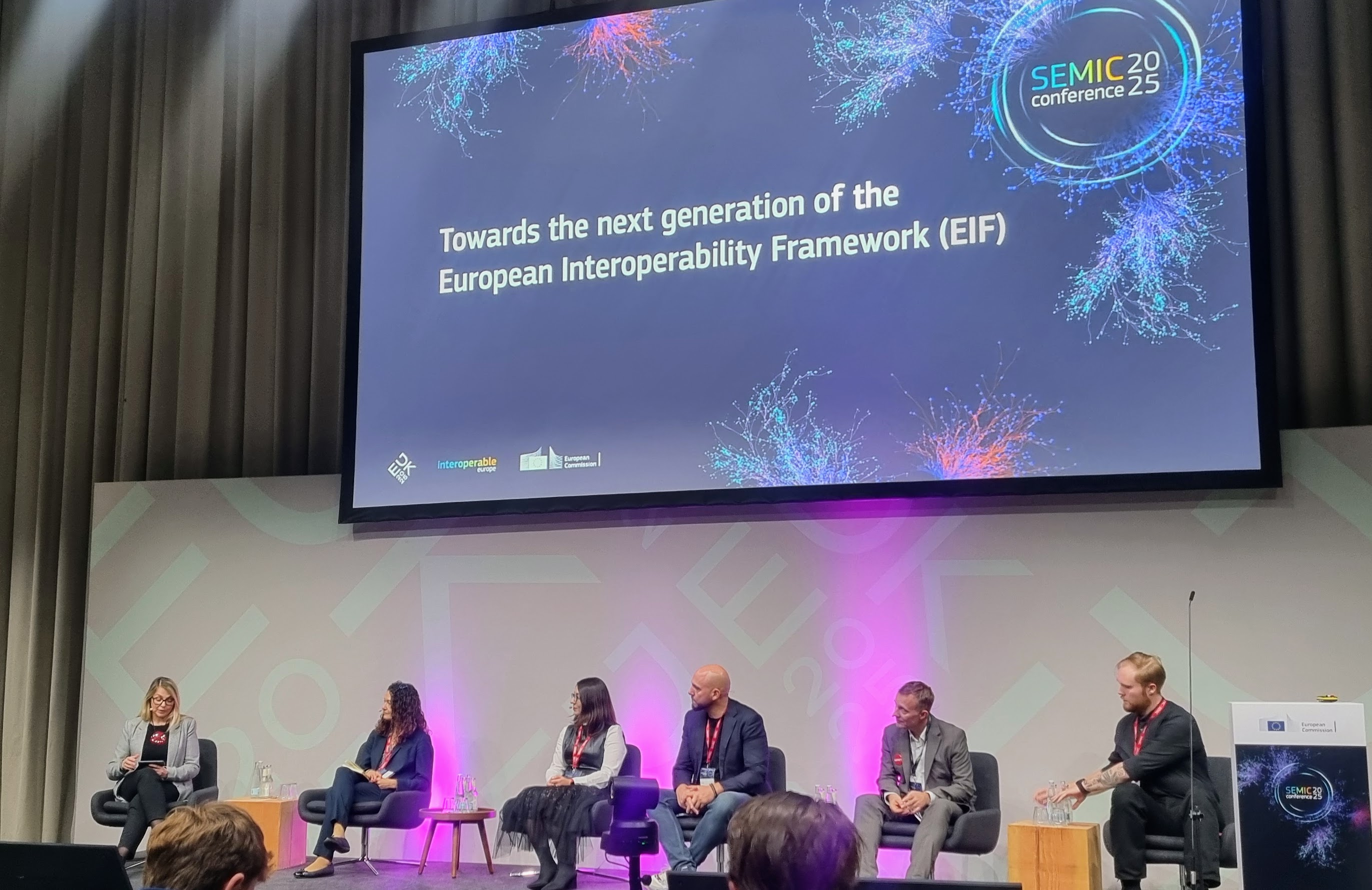
Overall, SEMIC always feels like a homecoming to me and I will keep attending it: it’s an amazing community of people working towards a common goal, both from the policy perspective and from the technical perspective. It’s where both perspectives meet.
It was great to catch up with old and new friends, who are too many to mention individually: Maria Keet, Ton Zijlstra, Tanja Ronzhina, Matthias Palmér, ... There was also a great delegation from Belgium/Flanders present.